
Every so often someone asks — usually half-jokingly, half-apologetically — why we in the Borders don’t speak French. After all, the Normans swept into England in 1066, built their castles, reorganised the land, and for centuries the ruling class preferred French. You see it in charters, in names, in the great houses whose families trace back to Normandy.
So why didn’t French ever take root along the Tweed?
The short answer is this:
The Normans brought French, but the Borders had no use for it.
To understand why, we need to look at who actually came here, and how the frontier worked. The Norman Conquest did not wash evenly across England. It was strongest in the south and east, where William’s authority was firm. The further north you went, the thinner Norman influence became — and by the time you reached the Borders, it had faded to transparency.
The Normans did come, of course. Families like the Umfravilles, Greys, Vescys and Nevilles established themselves from Prudhoe to Norham. They brought with them a French-speaking aristocratic culture: the language of courts, charters, law, and polite society. A lord at Norham Castle might speak French at high table, or when reading a charter sealed in London.
But step outside the castle gate and you were in a world where northern English — ancestor of modern Northumbrian and Scots — was the language of every byre, haugh, and market.
Languages survive not because the elite prefer them, but because ordinary folk adopt them. And here, Border farmers, shepherds, traders, monks and smiths had no reason to use French. Life on this frontier was about weather, livestock, kinship, harvests, raiding, and survival. The language that served those needs was already rooted in the soil.
There’s also the common misconception that medieval Scotland “spoke French” because its great families — Bruce, Stewart, Balliol, Comyn — had French names. In reality, French was never the everyday language of Scotland. Those families were invited, not imposed by conquest. They adapted quickly. The royal court spoke Gaelic; the burghs spoke Inglis, a northern English dialect remarkably close to the one spoken on the English side of the Tweed. A Scottish earl might read French for diplomacy, but he wasn’t using it to shout instructions at his men.
And remember — the Borders were never a calm, settled region where a cultured aristocracy might gently influence the populace. They were a pressure-point: raided, burned, rebuilt, raided again. When your cattle might vanish in the night, you don’t spend time adopting the elegant language of the nobility. You cling to what works. And what worked here was the tongue of the people — tough, practical, rooted.
Meanwhile, events in the wider world helped push French into decline. In 1204, England lost its last major holdings in Normandy, breaking the living link between the English aristocracy and their French homeland. French remained prestigious, but no longer “home.” Then came the Hundred Years’ War. From 1337 onward, the French became England’s enemy. French suddenly looked less like sophistication and more like disloyalty. English nobles raised their children in English again, and the shift spread quickly.
Here in the Borders, none of that mattered as much as the daily rhythm: droving cattle, tending sheep, watching weather roll off the Cheviots, listening for hoofbeats in the night. These were communities tied to land, kin, and habit. Their speech survived because it belonged to the landscape — as much as the dry-stone walls, the burns in their glens, and the vowel sounds still carried on the wind.
Of course French left fingerprints on English — especially in government, food, and law. Words like justice, marriage, beef, pork, captain, noble all seeped in from French administration. But in the Borders, the old words stayed stubbornly rooted: bairn, kye, haugh, burn, howk, clarty, loup, aye, and dozens more. Not French. Northumbrian and Scots — built for real life.
So why don’t we speak French in the Borders?
Because languages grow in the mouths of ordinary people, not in the halls of the powerful. The Normans planted French at the top of society, but the Borders never watered it. The land didn’t need it. The people didn’t want it. And the Border tongue — shaped by hills, wind, river and work — proved more resilient than any royal fashion.
Even now, if you listen in Coldstream, Kelso, Wooler or Jedburgh, you’ll catch echoes of that old northern English, alive under the modern accent. We may have taken French words for kings and courts, but the Border voice remained our own.
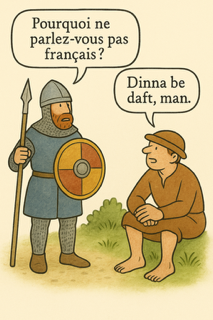
And if a Norman knight had ever wandered up the Tweed and asked for directions in perfect Parisian French, the likely answer — then as now — would have been something like:
‘Dinna be daft, man.’